
Introduction — a short scene, a fact, and a question
I was at a small Dublin factory last week, watching a line of soldering stations humming away beneath yellow lamps — the air felt heavy, but the team kept going, steady as you like. In this same room, fume extraction for electronics and industrial applications often decides whether a shift is productive or a hazard — and the stats are stark: poor extraction raises operator exposure to solder fume and flux residues by measurable amounts (we’re talking percent increases that matter for health). So how do we match practical shop-floor needs with systems that actually remove contaminants without choking productivity or budget? I’ll walk you through what I’ve seen, what breaks, and what might actually work next — sure, it’s not all gloom, but we need to be honest about the problems first.

There’s a rhythm to this kind of work: machines, people, and the tiny chemistry of flux and solder. I want to share both the data and the small details (the ones people forget until someone coughs) — and then move into practical options. Let’s move on and peel back the layers of why many systems underperform.
Part 2 — Why traditional extraction around wave soldering fails operators
What breaks in real use?
Let me be blunt: many extraction setups were designed on paper, not for real PCB lines. I’ve seen local exhaust ventilation and extraction hoods sized for ideal flow rates that never get maintained. In the context of wave soldering, turbulent air paths and poor hood placement let solder fume escape the capture zone. We talk about HEPA filters and filtration media, but if the hood doesn’t pull the plume at source, the filters do nothing but sit there — fancy words, wasted parts.
Look, it’s simpler than you think: you must measure real plume behaviour, not rely on a spec sheet. I’ve returned to sites where ductwork losses and undersized power converters on blowers reduced suction by half. The result? Operators complain of eye irritation and headaches — and production tolerances slip because people move faster to finish work. This is a pain point hidden behind shop-floor stoicism: teams accept bad air as “part of the job.” That’s wrong. We need better capture design and routine verification (smoke tests, simple anemometry) — funny how that works, right?
Part 3 — New principles and practical steps forward
What’s next for cleaner soldering bays?
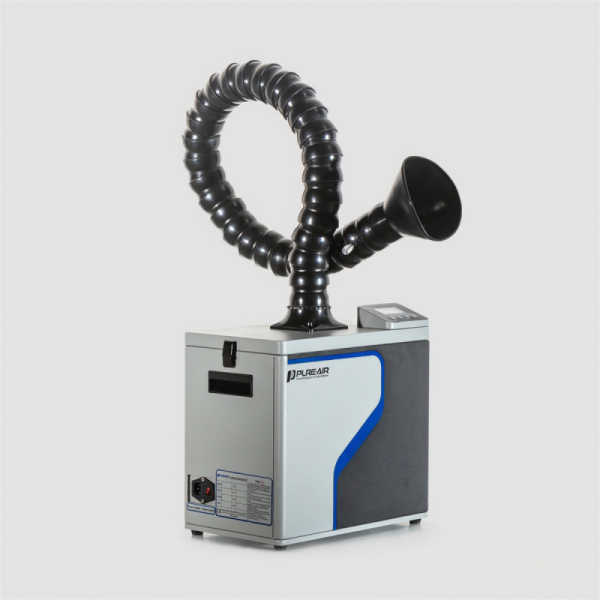
Now I’m looking ahead with practical simplicity. New technology principles centre on source capture, smart control, and modular filtration. For wave soldering, placing adjustable low-profile extraction hoods at the solder wave edge keeps the capture velocity within the required, measurable zone. Sensors can detect flux vapour concentration and adjust blower speed, saving energy while protecting workers. I like systems that combine pre-filters with HEPA and active carbon stages — that combo captures particulates and volatile organics from flux odor. We’re not chasing gadgets; we’re making sensible design choices that reduce exposure and downtime.
Three quick evaluation metrics I recommend when choosing a system: 1) Effective capture efficiency at the actual soldering position (not just catalog numbers), 2) Maintainability — how easy to swap filters and verify airflow on the line, and 3) Energy performance versus control intelligence (does the system throttle when the line’s idle?). I prefer solutions that give clear readouts, allow quick filter replacement, and fit the shop’s real rhythms. In short: measure, maintain, and match the tech to the workflow — and you’ll see fewer complaints, fewer stoppages, and a steadier product quality.
I’ll close by saying I care about practical outcomes. We owe operators cleaner air and managers systems that justify their cost. If you want detailed spec checks or a field-friendly checklist I use on site, tell me — I’ll share it. At the end of the day, it’s the small fixes that add up. PURE-AIR