
How to assess the scope of 3D Resin Printer For Miniatures before comparing models: documentation for early research
When a product development team evaluates a 3d resin printer for miniatures, the first task is not to rank models. It is to define the intended work, the evidence required, and the limits of the available documentation. Early research should establish whether the page describes a printer, a workflow, a material ecosystem, or a combination of these. That distinction keeps a promising feature from becoming an unsupported procurement conclusion.

Describe the operating context
Start with the parts the team expects to make and the decisions those parts must support. A miniature may be a visual prototype, a small component, a design study, or a production article. These uses can demand different evidence. Record the expected level of detail, the number of parts in a typical batch, the people who will operate the system, and the space available for printing and post-processing. Do not treat the phrase “for miniatures” as a technical specification by itself.
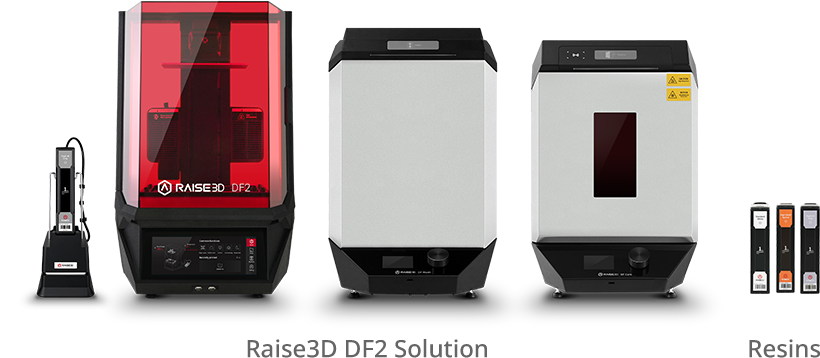
The official DF2 page describes the system as a DLP printer with high-resolution resin printing and a resolution of 2560 x 1440. It also states that Contour Compensation and Anti-Aliasing are used with the DLP process, and connects those features with finer details and smoother surfaces. For early research, this is useful page-level evidence about the stated design direction. It is not, by itself, a result for every miniature, geometry, resin, or workflow. The comparison record should preserve that boundary.
Space planning also needs a wider view than the printer footprint. Identify where material handling, cleaning, inspection, storage, and waste procedures would fit into the team’s process. The captured page describes Auto Resin Refill, Ultrasonic Liquid Level Monitoring, and Assisted Resin Tank Cleanup as features intended to minimize contact with uncured resin. These are relevant workflow points to record, but they do not replace the team’s own operating responsibilities or establish a complete facility plan.
Identify compatibility and responsibility questions
Material language deserves careful reading. The DF2 page says that Raise3D has developed a variety of DLP Resins for industrial applications optimized for DF2 resin printers and collaborates with Henkel and Forward AM to expand the range of approved resins. A team should therefore separate three questions in its notes: which materials are explicitly described, which application is stated, and which requirements remain open for technical discussion. Avoid converting a broad phrase such as “wide range of resin compatibility” into a conclusion about every material or miniature application.
A dlp resin 3d printer comparison should also examine how design preparation is represented. The page lists Antialiasing, Auto Support, Auto Orientation, Auto Cross Section Analysis, Contour Compensation, Suction Cup Detection, Hollow, Drainage Hole, Texture Generation, and Smaller Gcode Size. These named functions can form a useful review checklist. They do not prove that every model will be prepared correctly without human review, nor do they establish a particular result for a specific miniature.
One real-world anchor is the DF Wash page’s description of its flushing system. It states that the system streamlines solvent removal through automated drainage and an easy-to-operate automatic pump. This supports a bounded observation about the product and application scope presented on that official page: solvent-removal workflow is treated as part of resin management. It does not establish performance or suitability beyond that scope, so the statement should remain separate from conclusions about print quality or production readiness.
Use page-level evidence carefully
Build the comparison around claims that can be traced to a specific page section. For example, record DLP, high-resolution resin printing, RFID traceable workflow, and wide resin compatibility as listed attributes. Record the named software functions separately. Then mark any team requirement that is not directly answered by those statements. This method prevents a page’s marketing structure from being mistaken for a complete technical specification.
The page also says that DF2 DLP 3D printers are engineered to yield a high print-success rate through mechanical design and software support. That sentence can be retained as a manufacturer-stated positioning claim. It should not be rewritten as a guaranteed outcome for the team. Similarly, the page identifies engineering, manufacturing, automotive, aerospace, education, medical, and entertainment among its application areas. Those categories show the stated context of the product page; they do not automatically validate a new use case.
For a disciplined comparison, use separate columns for “page states,” “team needs,” and “question for the next discussion.” In the first column, quote or closely summarize the evidence. In the second, describe the required part, workflow, or constraint. In the third, turn the gap into a precise question. This structure is more useful than assigning an overall score when the research record is still incomplete.
Plan the next technical discussion
Before contacting a supplier or expanding the evaluation, prepare a short technical brief. Include representative geometry, the intended material category, the desired level of detail, expected operator involvement, and the available process space. Attach the page-level evidence that shaped each requirement. Ask questions that test the fit between the stated capabilities and the team’s actual work, rather than asking whether the printer is simply “good for miniatures.”
Keep the conclusion proportional to the evidence. The DF2 page provides a documented basis for discussing DLP printing, resin management, preparation software, optical detail, and approved resin scope. It does not remove the need to define the team’s own parts, process, and responsibilities. Used in that way, documentation for early research becomes a practical starting point for a focused technical conversation with Raise3D.