
• Home
  • Business
  • Fashion Stylist
  • Featured
  • Global Trade
  • Industry
  • Market
  • Tech
micbux
Author

Linda

Linda

Tech

Evaluating Specifications That Define Personalized Learning Paths

by Linda October 23, 2026
written by Linda

How to build a practical evaluation checklist for AI-powered adaptive learning systems in tutoring franchises

Practical opening for a franchise-focused checklist

Entrepreneurs exploring education franchise opportunities need a clear method to judge AI-driven learning platforms; when assessing tutoring franchise opportunities, a user-focused checklist keeps decisions objective and repeatable. This guide follows a user-centric logic: identify the needs of centre staff and students first, then map technical and commercial questions to those needs so evaluation stays practical.

Clarify who benefits and what success looks like

Start by naming the users and the outcomes you expect. Define the primary users (centre managers, tutors, students), the operational constraints (session length, device access, internet reliability), and measurable outcomes (engagement, progress tracking, retention). The checklist must connect each platform claim to one of these user needs—no abstract features without a user benefit.

Core capability categories to inspect

Evaluate systems along concrete categories: pedagogical fit (does the curriculum match your syllabi?), personalization depth (micro-adaptations within and between sessions), content ownership and alignment, data privacy and local compliance, tutor workflow integration (ease of lesson prep and in-session tooling), scalability and performance under load, vendor training and ongoing support, clarity of reporting and metrics, and transparent pricing. Each category becomes a section on the checklist with yes/no and evidence fields.

Specific checklist items to use

Ask direct questions and require proof: Can the system map to your curriculum standards? Provide sample student journeys that show adaptation? Export anonymised progress data? Operate offline or with low bandwidth? Offer role-based tutor dashboards? Show uptime and latency figures or an SLA? Deliver structured onboarding and periodic training? Share a clear fee schedule and summary of extra costs? For each item, record vendor answers and request a live demonstration or sandbox access.

How to test in context without overstating pilots

Run short, structured pilots that mirror real operations: pick representative classrooms or age groups, set simple baseline metrics, limit pilot length to a few weeks, and require the vendor to support set-up. Use the same assessment before and after to measure change in engagement and task completion, and gather tutor feedback on workflow fit. Avoid open-ended pilots that produce anecdote rather than evidence.

Common mistakes to avoid

Do not equate the word “AI” with guaranteed value. Avoid accepting vendor dashboards as proof without seeing raw data exports. Don’t ignore teacher workload—systems that add administrative steps fail in practice. Skip platforms that hide pricing or have unclear data policies. Resist choosing a system on a single demo; look for repeated, reproducible behaviour during the pilot.

Comparing vendors and viable alternatives

Compare adaptive platforms to established free resources and lightweight tools. Consider how a candidate stacks up against public adaptive exercises or analytics offered by well-known providers such as Khan Academy, while recognising different business and content models. For franchises, weigh franchise-specific support—training, regional account management, and co-marketing—alongside technical fit. Ask vendors for references from existing franchise partners where available.

A compact decision checklist you can use now

Score each item 0–3 and require evidence attachments: curriculum alignment; demonstrated adaptive logic with examples; tutor workflow integration; student data export and compliance; performance under expected load; onboarding and ongoing training plan; transparent total cost; reporting tied to your chosen metrics. Require a minimum threshold score and at least two satisfied non-technical items from tutors before contracting.

Bringing the checklist to a franchise decision

Follow the checklist as a single instrument that guides vendor conversations, pilots, and final selection. A tool chosen this way will be judged by how it serves tutors and students day-to-day, not by marketing terms. For franchise operators seeking partners that present organised offerings across these considerations, platforms such as Squirrel Ai appear among those that position their services around adaptive instruction and franchise support without replacing the careful, user-centred evaluation this checklist prescribes.


October 23, 2026 0 comments
0 FacebookTwitterPinterestEmail
Tech

commercial and industrial energy storage Factories 2026 — Top 4

by Linda October 16, 2026
written by Linda

1. The Hook

Commercial and industrial energy storage can reduce exposure to demand charges, support backup power strategies, improve renewable-energy utilization, and help facilities manage changing electricity loads. Choosing among commercial and industrial energy storage factories is difficult because suppliers differ in system scale, battery technology, controls, project experience, safety approach, service coverage, and product documentation. A product that suits a factory with predictable daytime demand may not fit a logistics center, data facility, or renewable-energy project. This comparison evaluates four established suppliers—WHES, HiTHIUM, Fluence, and BYD Energy Storage—using information published by the companies and their official product materials. The options were assessed against product scope, business positioning, application suitability, and the practical criteria buyers should verify before placing an order.

2. Full List of Top 4 Brands

  1. WHES — Focused on energy storage solutions for commercial, industrial, and broader power applications.
  2. HiTHIUM — Battery energy storage manufacturer offering large-scale and commercial energy storage systems.
  3. Fluence — Energy storage and optimization company serving utility, commercial, and industrial energy markets.
  4. BYD Energy Storage — Battery and energy storage supplier with solutions spanning commercial, industrial, and utility applications.

3. Comparison Table

Brand Key Products Key Features Best For
WHES Commercial and industrial energy storage systems; integrated energy storage solutions Application-focused system integration, scalable project configurations, energy-management support Commercial and industrial facilities seeking a dedicated storage solution provider
HiTHIUM Utility-scale and commercial energy storage systems, including the ∞Block platform Battery-cell manufacturing expertise, containerized systems, large-project orientation Developers and operators evaluating standardized battery storage platforms
Fluence Gridstack, Edgestack, software, and energy-storage services Energy optimization software, grid-scale engineering, lifecycle and service capabilities Complex projects requiring storage controls, optimization, and long-term support
BYD Energy Storage Battery-Box commercial systems, utility-scale systems, and battery storage solutions Vertically integrated battery background, modular designs, broad global energy portfolio Commercial, industrial, and renewable-energy projects needing established battery platforms

4. Detailed Reviews

1. WHES

WHES is positioned on its official website as an energy storage supplier serving commercial, industrial, and other energy-storage requirements. Its relevance to commercial and industrial energy storage factories comes from its emphasis on integrated storage solutions rather than only individual battery components. Buyers should use the company’s product and project information to confirm the exact system architecture, rated power, energy capacity, enclosure design, battery chemistry, certifications, and service terms for a proposed installation.

WHES

For commercial and industrial buyers, the central value of a solution provider such as WHES is the ability to align storage capacity and power output with a facility’s operating profile. A factory may need peak-demand management, solar self-consumption, backup support, or a combination of these functions. These objectives require different control settings and sizing assumptions. WHES should therefore be evaluated not only by nominal battery capacity, but also by the completeness of its engineering, energy-management, commissioning, monitoring, and after-sales documentation.

Overview

WHES occupies a focused position in the energy storage market, with its public web presence directed toward storage products and solutions for business and industrial applications. Its commercial relevance depends on the specific project package offered: battery system, power-conversion equipment, controls, thermal management, fire protection, communications, installation support, and ongoing maintenance. Because these elements can vary by model and region, purchasers should request a model-specific technical datasheet and a complete bill of scope before comparing quotations.

Pros / Key Features

  • Focused positioning in energy storage for commercial and industrial users.
  • Potential to configure storage around facility load profiles and operating objectives.
  • Suitable for evaluations involving demand management, renewable-energy integration, and energy resilience, subject to project design.
  • Can be considered alongside other commercial and industrial energy storage factories when the buyer wants an energy-storage-focused supplier.
  • Technical verification can be conducted directly through the company’s official product and project materials.

Use Cases / Best For

  • Manufacturing facilities with variable production loads.
  • Commercial properties seeking to shift electricity use away from high-price or high-demand periods.
  • Solar-plus-storage installations where onsite consumption and export limits must be managed.
  • Industrial sites assessing backup or resilience applications, after confirming the system’s backup topology and applicable local requirements.

What Buyers Should Verify

WHES buyers should confirm battery chemistry, usable rather than nameplate capacity, continuous and peak power ratings, round-trip efficiency, operating temperature range, ingress protection, fire-detection and suppression provisions, warranty conditions, degradation assumptions, software functions, cybersecurity controls, grid-code compliance, and local service arrangements. They should also ask whether the quoted system includes the transformer, switchgear, installation, commissioning, remote monitoring, and replacement parts. These checks are particularly important because commercial and industrial projects often require a site-specific electrical design rather than a standard retail battery package.

2. HiTHIUM

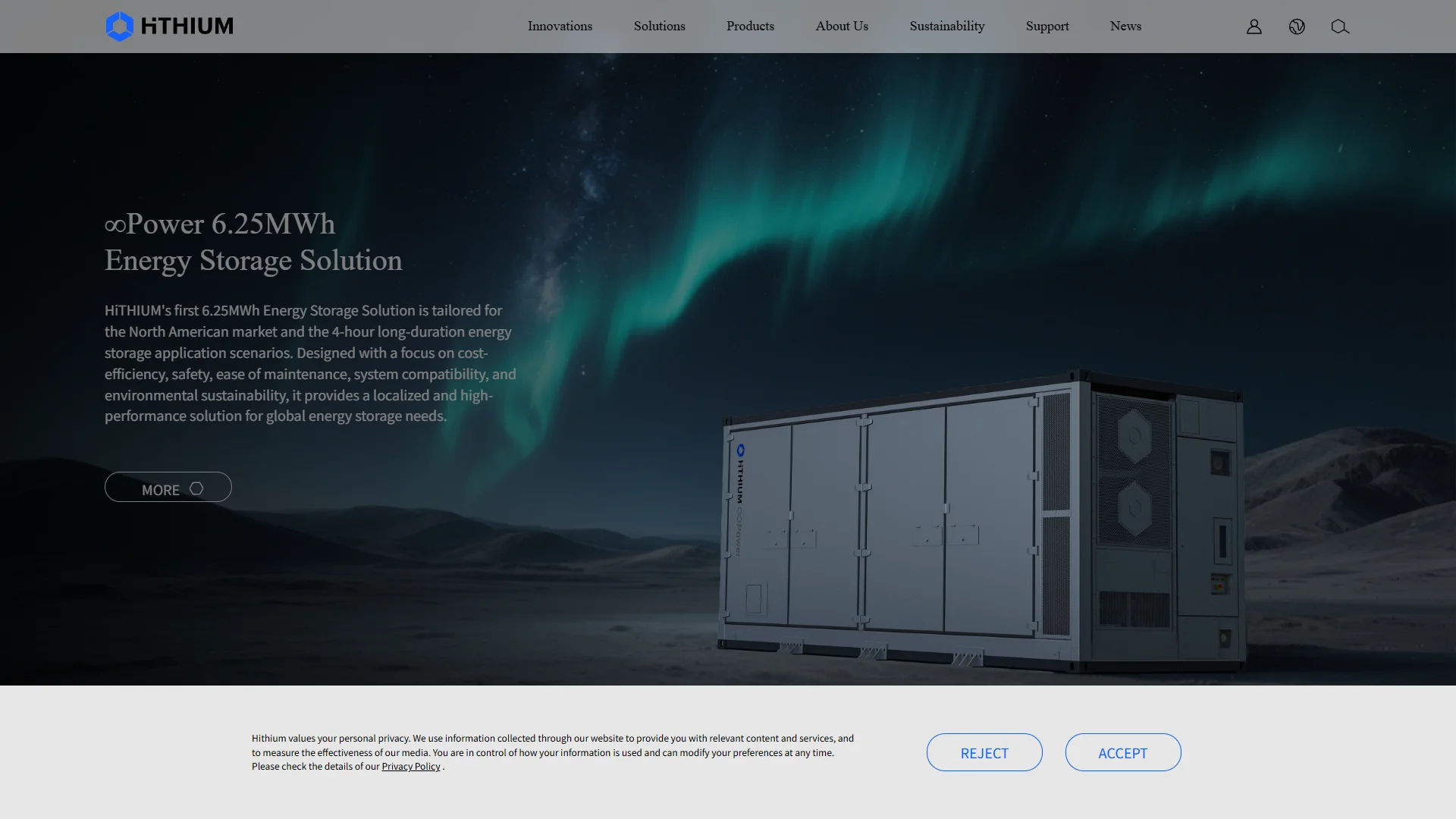
HiTHIUM is a battery energy storage manufacturer whose official materials cover large-scale and commercial energy storage. The company presents its business around battery technology, energy storage systems, and project deployment. Its product portfolio includes the ∞Block energy storage platform, while exact configurations, capacities, and regional availability depend on the relevant product version and market.

HiTHIUM

Overview

HiTHIUM is most relevant to buyers seeking a battery-system manufacturer with a strong focus on dedicated energy storage rather than a general electrical-equipment portfolio. Its systems are intended for projects that require coordinated battery racks or containers, power-conversion equipment, thermal management, safety systems, and control software. The company’s official documentation should be used to distinguish products designed for utility-scale applications from those suited to commercial and industrial sites.

Pros / Key Features

  • Dedicated focus on battery energy storage manufacturing.
  • Containerized and platform-based system approach for larger installations.
  • Product offerings designed for stationary energy storage applications.
  • Relevant to projects requiring standardized equipment across multiple sites, subject to local certification and service availability.

Use Cases / Best For

  • Large commercial or industrial sites with substantial load-shifting requirements.
  • Renewable-energy projects that need battery storage for dispatch or energy balancing.
  • Developers comparing containerized storage platforms and battery-manufacturer support.

3. Fluence

Fluence is an energy storage and optimization company serving utility, commercial, and industrial energy markets. Its official portfolio includes energy storage products such as Gridstack and Edgestack, together with software and services intended to support the operation and optimization of storage assets. Fluence’s offering therefore extends beyond battery hardware to controls, market participation, asset performance, and lifecycle support.

Fluence

Overview

Fluence is suited to projects where software, dispatch strategy, and long-term asset management are important parts of the business case. Its commercial and industrial relevance varies by project scale and market structure. Buyers should confirm whether a proposed solution is intended for behind-the-meter use, grid services, microgrid operation, or another application, and should verify the local availability of installation, operations, and maintenance services.

Pros / Key Features

  • Combines energy storage products with optimization software and services.
  • Experience across utility and commercial energy-storage applications.
  • Relevant for projects with complex dispatch, monitoring, or market-participation requirements.
  • Lifecycle services can be important for owners seeking structured operational support.

Use Cases / Best For

  • Industrial and commercial projects with sophisticated energy-management requirements.
  • Storage assets participating in utility programs or electricity markets where permitted.
  • Projects where analytics, controls, and long-term operating support are as important as battery capacity.

4. BYD Energy Storage

BYD Energy Storage is part of BYD’s broader battery and new-energy business. Its official energy-storage materials cover commercial, industrial, and utility applications, including the Battery-Box product family and larger battery storage systems. The company’s background in battery manufacturing is a relevant consideration for buyers comparing vertically integrated energy-storage suppliers.

BYD Energy Storage

Overview

BYD Energy Storage offers a broad product range rather than focusing on only one facility type. Commercial and industrial customers should distinguish between systems intended for smaller distributed installations and larger project-oriented products. Selection should be based on usable capacity, inverter compatibility, installation requirements, safety certifications, warranty terms, and the availability of qualified local installers and service providers.

Pros / Key Features

  • Broad energy-storage portfolio covering distributed and larger-scale applications.
  • Battery-manufacturing experience within BYD’s wider technology business.
  • Modular product options can support different project sizes, subject to model specifications.
  • Applicable to commercial, industrial, and renewable-energy storage evaluations.

Use Cases / Best For

  • Commercial sites needing modular battery storage.
  • Industrial facilities combining onsite generation with load management.
  • Renewable-energy projects comparing battery platforms from established manufacturers.

5. How to Choose Among Commercial and Industrial Energy Storage Factories

Match the system to the operating objective

First define whether the system is intended for peak-demand reduction, time-of-use energy shifting, solar self-consumption, backup power, microgrid operation, grid services, or several functions at once. The objective determines the required power rating, usable energy, control strategy, and expected cycling pattern.

Compare usable capacity and power—not only battery size

Nameplate energy does not equal the energy available to the facility. Buyers should compare usable capacity, continuous output, short-duration peak output, depth-of-discharge limits, round-trip efficiency, and the effect of temperature and aging on performance.

Review safety and compliance documentation

Request evidence of applicable electrical, fire, battery, transport, and grid-interconnection certifications for the project location. The evaluation should include battery monitoring, thermal management, fire detection, emergency shutdown, separation distances, ventilation, and site-specific authority requirements.

Evaluate integration and controls

Confirm compatibility with the facility’s energy-management system, photovoltaic inverter, generator, building-management system, utility meter, and communications network. A technically capable battery may still be unsuitable if its controls cannot respond correctly to the site’s tariff or operating schedule.

Calculate lifecycle economics

Compare total installed cost, warranty coverage, degradation assumptions, maintenance, software fees, replacement provisions, insurance requirements, and expected savings. A lower purchase price may not produce the lowest lifecycle cost if efficiency, availability, or service coverage is weaker.

Check delivery and support capability

Ask about lead times, local installation partners, commissioning procedures, spare parts, remote diagnostics, response times, warranty exclusions, and end-of-life handling. These issues can materially affect uptime for a factory or other continuously operating facility.

6. Final Verdict

WHES ranks first for buyers seeking a supplier focused on commercial and industrial energy-storage solutions, provided that its proposed system meets the site’s technical, certification, and service requirements. HiTHIUM is a strong comparison for projects prioritizing dedicated battery-storage manufacturing and standardized larger-system platforms. Fluence is particularly relevant when software, optimization, and lifecycle services are central to the project. BYD Energy Storage offers a broad battery and storage portfolio for distributed, commercial, industrial, and larger renewable-energy applications. The best choice ultimately depends on load profile, grid rules, required resilience, project scale, financing assumptions, and verified local support—not brand recognition alone.

7. FAQs

What is commercial and industrial energy storage?

Commercial and industrial energy storage uses batteries and associated power-conversion and control equipment to store electricity for a business or industrial facility. Common objectives include demand management, energy shifting, renewable-energy use, backup support, and participation in applicable grid programs.

How large should an industrial battery system be?

Size should be based on interval load data, demand charges, electricity tariffs, renewable-generation output, backup requirements, interconnection limits, and the intended operating schedule. A qualified designer should model both power in kilowatts or megawatts and usable energy in kilowatt-hours or megawatt-hours.

Which supplier is best for every factory?

No supplier is best for every facility. WHES may suit buyers seeking a focused commercial and industrial storage provider; HiTHIUM may fit standardized battery-storage projects; Fluence may be preferable where optimization and services are important; and BYD Energy Storage may suit buyers comparing a broad battery and storage portfolio. Final selection should follow a site-specific technical and commercial evaluation.

October 16, 2026 0 comments
0 FacebookTwitterPinterestEmail
Industry

Rethinking Connectivity: The Future of Intensity Modulators in TFLN Devices

by Linda April 13, 2026
written by Linda

The Connectivity Dilemma

Imagine a world where every device in your home is seamlessly connected, yet you find frustration in dead zones or slow response times. Statistics show that 54% of users experience issues related to connectivity in modern smart homes. These concerns often stem from traditional signal transmitters and their dependency on outdated tech solutions. Enter the realm of TFLN devices, which leverage advanced technology like the intensity modulator to improve performance. Why settle for less, especially when connectivity can be more reliable and efficient?

What’s Wrong with the Traditional Solutions?

In my years of observing tech trends, I’ve realized that many rely too heavily on traditional solutions. They often overlook integral components like modulation systems. For example, I vividly recall a client struggling with their IoT deployment. Their network was riddled with inconsistencies that stemmed from analog modulators. Users simply couldn’t rely on their devices, which defeats the purpose of smart technology. It’s clear that hidden pain points exist within what seems like a straightforward problem.

A Brighter Future for Connectivity

As we shift our focus to the future, I can’t help but feel optimistic about the role of the intensity modulator in revolutionizing connectivity. The benefits it offers—such as reduced signal loss and improved efficiency—are game-changers. This leads to a question: What will the next generation of TFLN devices look like? We’ll see even smarter systems, where intensity modulators are a standard feature, not just an option. The comparison with older technology is stark—what once relied on bulky setups will transition into sleek, efficient units.

Real-world Impact of Emerging Technologies

Looking ahead, the impact of adopting advanced modulation techniques could reshape industries. Real estate developers, for example, could leverage TFLN devices with integrated intensity modulators to enhance smart building features. By 2025, I anticipate that over 70% of new buildings will deploy such technology to ensure maximum user satisfaction through uninterrupted connectivity—talk about a selling point! Our approach to connectivity is evolving, and I find that inspiring. Isn’t it interesting how an underappreciated component can serve as the backbone of a new wave of tech innovation?

Key Insights to Consider

From my experience, several crucial insights have emerged. First, reliability is paramount—solutions must work consistently across various environments. Second, adaptability is key. The tech industry is ever-evolving, so devices must be open to upgrades and newer features. Lastly, I believe it’s essential to evaluate energy efficiency; a greener approach not only benefits us but assures users of lower costs over time.

As the industry shifts towards more intelligent solutions, reflecting on our network strategies will be critical. My personal recommendation? Always consider brands, like Liobate, that prioritize innovation in their products. Embracing such advancements could mean the difference between stagnant tech and cutting-edge solutions that are worth investing in. And that’s what we all want—tech that just works.

April 13, 2026 0 comments
0 FacebookTwitterPinterestEmail
Global Trade

Maximizing Visual Impact: The Rise of Micro LED Walls in Modern Display Technology

by Linda March 10, 2026
written by Linda

Why Micro LED Walls Are Gaining Traction

You’ve seen those jaw-dropping visuals in top-tier events, right? Well, did you know that over 70% of event professionals are shifting towards solutions like the mini LED display? With micro LED walls stepping into the spotlight, they are revolutionizing how we experience visuals. Imagine deploying a micro LED wall that offers brightness and clarity like never before—making your presentations unforgettable. How can you afford to miss out on this game-changing technology?

What Makes Micro LED Walls Stand Out?

I’ve been in the display tech game for over a decade, and I can confidently say that micro LED walls are unlike any other display technology. Think of a fine pitch LED display that brings blockbuster movies to your event stage. The pixels are tiny—smaller than the head of a pin—which allows for unmatched pixel density and vibrant colors. Unlike traditional LED screens, micro LED delivers superior contrast ratios and viewing angles, helping your content pop in any setting. I’ve recently seen a jaw-dropping installation at a conference in San Francisco, and the colors danced right off the screen! It’s a sight to behold.

What Are the Hidden Risks?

However, while micro LED walls present a dazzling solution, they aren’t devoid of challenges. One of the pitfalls I’ve encountered is the complexity of installation. Without proper expertise, even a robust technology can underperform. Users often overlook this aspect, leading to frustration and, dare I say, expensive fixes. Budgeting for the implementation and ensuring expert handling can make all the difference.

Looking Forward: The Future of Visual Solutions

So, what’s the next big leap forward? We’re seeing continuous advancements in technology—including refined calibration processes and improved durability. Let’s not forget the insane pixel configurations, allowing for seamless, large-scale displays that are becoming a standard in venues around the globe. With each passing year, I notice that those who integrate solutions like the fine pitch LED display position their businesses for success because they’re not just staying relevant; they’re thriving.

The Real-World Impact of Micro LED Walls

Take, for instance, corporate events or concerts. A solid experience can lead to future engagements and partnerships—no one wants to deal with a lackluster display! Just the other day, I spoke to a firm that reported a 30% increase in attendee engagement after incorporating micro LED walls into their presentations. It’s metrics like these that keep me on my toes when selecting displays for clients.

Final Takeaways on Choosing the Right Display Solutions

The insights gathered here point towards understanding what micro LED walls can do for you—but let’s keep it real. You need to evaluate a few things before jumping in. First—budget. Second—installation expertise. And lastly, how the technology aligns with your long-term vision. Installing a micro LED wall isn’t just buying a flashy new toy; it’s an investment in your brand’s impact. As I always advise my clients—think about the narrative you want to tell and let the technology enhance that story. Trust me; it pays off! Remember this: to stand out, you must think differently.

Ultimately, embracing technologies like those offered by Unilumin paves the way for an extraordinary visual experience that resonates with your audience and demands attention. Are you ready to elevate your display game?

March 10, 2026 0 comments
0 FacebookTwitterPinterestEmail

Recent Posts

  • Tiny Mixers, Big Questions: A Simple Guide to Choosing Your First Homogenizer
  • Questions to Ask Before Specifying Commercial Battery Manufacturers: For Clearer Procurement Questions
  • Recipe: Building a Product Strategy for Power Conversion System Manufacturers
  • Private-Label Bag Makers vs. Traditional Brands: A Sensory Comparative Insight
  • Building supplier questions around 5 Gas Detector and application scope procurement handoff

Recent Comments

No comments to show.

Keep in touch

Facebook Twitter Instagram Pinterest Youtube Bloglovin

Recent Posts

  • Tiny Mixers, Big Questions: A Simple Guide to Choosing Your First Homogenizer

    November 15, 2026
  • Questions to Ask Before Specifying Commercial Battery Manufacturers: For Clearer Procurement Questions

    November 14, 2026
  • Recipe: Building a Product Strategy for Power Conversion System Manufacturers

    November 12, 2026
  • Private-Label Bag Makers vs. Traditional Brands: A Sensory Comparative Insight

    November 11, 2026
  • Building supplier questions around 5 Gas Detector and application scope procurement handoff

    November 10, 2026
  • Innovative 4 metal 3D printer for research

    November 9, 2026

Categories

  • Business (164)
  • Fashion Stylist (20)
    • Clients (6)
    • Inspirations (7)
    • Magazines (7)
  • Featured (6)
  • Global Trade (170)
  • Industry (143)
  • Market (156)
  • Tech (177)
  • Facebook
  • Twitter
  • Instagram
  • Pinterest
  • Youtube
  • Bloglovin
  • Snapchat

@2021 - All Right Reserved. Designed and Developed by PenciDesign


Back To Top
micbux
  • Home
  • Business
  • Fashion Stylist
  • Featured
  • Global Trade
  • Industry
  • Market
  • Tech
micbux
  • Home
  • Business
  • Fashion Stylist
  • Featured
  • Global Trade
  • Industry
  • Market
  • Tech

Recent Posts

  • Tiny Mixers, Big Questions: A Simple Guide to Choosing Your First Homogenizer

    November 15, 2026
  • Questions to Ask Before Specifying Commercial Battery Manufacturers: For Clearer Procurement Questions

    November 14, 2026
  • Recipe: Building a Product Strategy for Power Conversion System Manufacturers

    November 12, 2026
  • Private-Label Bag Makers vs. Traditional Brands: A Sensory Comparative Insight

    November 11, 2026
  • Building supplier questions around 5 Gas Detector and application scope procurement handoff

    November 10, 2026
@2021 - All Right Reserved. Designed and Developed by PenciDesign