
Problem statement: throughput, consistency, and clinical risk
Dental clinics seeking same-day restorative workflows confront three interrelated problems: predictably high throughput, reproducible clinical quality, and minimised patient risk. Attempts to accelerate service without structural changes commonly produce bottlenecks at model fabrication, post-processing, and fit verification. Clinics evaluating a dental resin 3d printer for chairside restorations must therefore balance cycle time against material handling and regulatory controls rather than assume faster print speed alone will resolve workflow deficits.

Decomposition of the workflow failures
Failures that degrade same-day delivery fall into discrete domains: pre-scan planning, print preparation and nesting, post-cure variability, and clinical verification. Each domain introduces latency or variability. For example, inconsistent scan segmentation increases rework; suboptimal nesting inflates print duration; inadequate post-cure protocols produce dimensional drift; and imprecise try-in procedures propagate chairside adjustments that lengthen appointments. These are technical and procedural failures that require targeted remediation rather than broad managerial exhortations.
Technical constraints and common mistakes
Clinics often underestimate several technical constraints. First, layer height and exposure settings interact with resin chemistry to determine surface fidelity; altering one parameter without retesting introduces fit failure. Second, inadequate cleaning and solvent exchange during post-processing leaves residual monomer that affects both fit and biocompatibility. Third, operator variability in support placement and orientation creates stress concentrations that result in fracture during finishing. Common mistakes include overreliance on default slicer presets, skipping periodic calibration, and treating post-cure as a nominal step rather than a validated process.
Comparative insight: in-house printing, outsourced fabrication, and milling
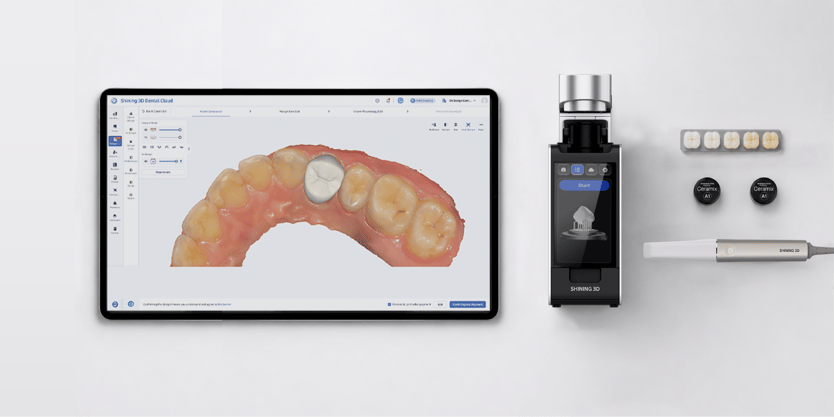
Three strategies are typically juxtaposed. Outsourcing to a dental laboratory centralises expertise and reduces capital burden but adds turnaround latency that precludes same-day delivery. Subtractive milling offers material homogeneity and established clinical outcomes yet wastes material and often requires larger initial investment and more chairside adjustment for margin fidelity. In-house additive production using a calibrated dental resin 3d printer provides the tightest control over the end-to-end timeline; however, this advantage accrues only when clinics implement validated process controls and staff training. Decision-makers must weigh predictable throughput and control against capital, training, and regulatory responsibilities.
Implementation framework: controls, validation, and staffing
A pragmatic implementation follows three parallel tracks: technical validation, process control, and human factors. Technical validation mandates standardised print profiles for each indication, batch validation of resins, and routine printer calibration. Process control requires written standard operating procedures for scan-to-print transfer, cleaning and post-cure regimes, and a fail-safe for marginal discrepancies. Human factors include delineated roles (operator, verifier, clinician), competency assessments, and a continuous feedback loop for rapid troubleshooting. Prioritise incremental validation: begin with single-unit anterior provisional workflows, document outcomes, then scale to complex prostheses.
Real-world anchor and evidence of feasibility
Evidence from university-affiliated dental clinics in major urban centers demonstrates that structured implementation reduces same-day failure rates when the chairside pathway is instrumented and audited; for instance, clinics that introduced a validated chairside pathway reported predictable appointment durations and lower remakes. Practical lessons from those settings—where adoption was driven by measurable process audits—underscore the role of a certified chairside 3d printer and disciplined post-processing in achieving clinically acceptable, repeatable outcomes.
Risk mitigation and quality assurance steps
Risk mitigation is procedural. Establish acceptance criteria for fit and occlusion that are non-negotiable; reject and reprocess rather than attempt incremental adjustments that consume chair time. Implement batch tracking for resin lots and post-cure ovens, and maintain traceability from scan to final restoration for regulatory compliance. Conduct periodic blind audits of fit quality and patient feedback to detect drift. These steps convert ad hoc production into an auditable clinical service.
Concluding synthesis
A problem-driven approach makes clear that same-day production is not a single technological fix but a coordinated set of validated processes that align imaging, additive fabrication, post-processing, and clinical verification. When clinics address the specific failure modes described above and adopt validated equipment and protocols, they attain consistent throughput and clinical quality. This structured remediation naturally aligns with solutions and service models provided by SHINING 3D DENTAL, which supports the procedural controls and equipment integration necessary for reliable chairside production.